
Alcohol Alert October 2025
Government plans licensing deregulation; The alcohol harm productivity crisis; Killer Tactics 2; Industry ramps up duty cuts campaign; MSPs reject right to recovery Bill.

Hello and welcome to the Alcohol Alert, brought to you by The Institute of Alcohol Studies.
In this edition:
IAS blogs
Government plans deregulation of licensing in threat to public health
Alcohol harm: A hidden productivity crisis in the UK workforce 🎵 podcast feature 🎵
Killer Tactics 2: Business as usual
Tens of thousands of essential frontline workers could be funded by alcohol duty
Alcohol industry ramps up pressure on government for tax cuts despite near record sales
Half of alcohol-free adverts break the rules
“Can we really trust what our children are being taught?”
MSPs vote against legal right to addiction treatment
WHO Western Pacific countries adopt landmark alcohol policy plan
Alcohol Toolkit Study: update
We hope you enjoy our roundup of stories below: please feel free to share. Thank you.
IAS blogs
To read blogs click here.

Government plans deregulation of licensing in threat to public health
The UK government is pressing ahead with proposals to deregulate alcohol licensing, in what it says is a “pro-growth vision” to support the hospitality industry. Ministers say the reforms aim to give businesses greater flexibility to invest and respond to changing consumer trends, while still protecting local communities. Yet critics from numerous industries have criticised the proposals and the process, which would redefine the purpose of licensing from public protection to promoting private commercial interest.
Kate Nicholls, CEO of UKHospitality and a member of the Taskforce that recommended these reforms, called the proposals “a huge boost to the nation’s pubs, bars, restaurants and hotels”. Nick Mackenzie, CEO of pub chain Greene King and Co-Chair of the Taskforce, argued that existing restrictions “often limit premises’ ability to respond to changing circumstances and customer demand”.
Some smaller operators, however, have warned that extended hours won’t solve their problems. Mark Costello, who runs a brewery and taproom in Leeds, said:
“It doesn’t matter how long we’re allowed to stay open; it costs a huge amount to stay open so what we need is the customers to fill the place, and they don’t have the money to go out like they used to. We need help with business rates, energy and staffing costs.”
Public health experts have been quick to warn of the risks associated with looser licensing rules. Dr Katherine Severi, Chief Executive of the Institute of Alcohol Studies, told The Guardian that:
“Licensing is not a tool for economic growth – it is a public protection mechanism. Using it to deregulate alcohol sales in the name of business growth is misguided and irresponsible, especially when those businesses are contributing to record levels of harm and placing enormous strain on our health services and communities.”
Dr Richard Piper, Chief Executive of Alcohol Change UK, added:
“One of the biggest things that people across the country are desperate to see is safer streets with less antisocial behaviour. Yet these proposals – little more than an alcohol industry wish-list – would deliver the opposite.”
The Association for the Directors of Public Health (ADPH) said that these measures would:
“undoubtedly increase alcohol harm – both through ill health and the impact of violence… while we all want to see growth in the economy, quick savings that are made at the expense of people’s health and wellbeing will not only be harmful for individuals and their families, but also to the economy through lost productivity and increased demand on our health and social care services.”
The Health Foundation echoed these concerns, highlighting that later pub hours may provide short-term business benefits but risk worsening long-term health inequalities and alcohol-related harms, which already cost the UK economy billions of pounds annually.
Local policing authorities are similarly concerned. Joy Allen, Police and Crime Commissioner for Durham and Darlington, warned that extended hours would likely increase alcohol-related violence, health problems, and pressure on public services.
“Alcohol-related crime already costs the North East around £812 million a year and is linked to about 700,000 violent incidents,” Allen said. “Who will pay for the extra policing costs if venues stay open later?”
Critics argue the government’s Licensing Taskforce is heavily influenced by industry interests. Licensing experts from the University of Stirling, Dr James Nicholls and Professor Niamh Fitzegerald, argued in Addiction journal that this was a clear case of ‘regulatory capture’, with the Taskforce excluding public health bodies and focused on promoting business growth rather than safeguarding the public from alcohol-related harms.
“Conducted at speed, with minimal public scrutiny, systematically excluding health considerations and dominated by commercial interests, it constitutes a clear case of ‘regulatory capture’.”
A threat to local newspapers and transparency
The government’s plans would also remove the legal requirement for changes to alcohol licences to be advertised in local newspapers, a move critics say undermines transparency and community involvement. Laura Davison, general secretary of the National Union of Journalists (NUJ), called the proposals “a double blow to local papers and the public,” noting that newspapers remain essential for digitally excluded populations.
Local councils and media groups have joined the opposition. Cornwall Council leader Leigh Frost said the move could leave residents “in the dark” about new or extended pubs and nightclubs. Danny Cammiade, chairman of the News Media Association, warned that removing alcohol licensing notices from print would “undermine this work and leave local communities shrouded in secrecy.”
The government maintains that its goal is to strike a balance between business flexibility and community protection. However, public health advocates, local journalists, police leaders, and concerned citizens have urged the government to reconsider the reforms.
With the call for evidence window closing on 06 November, IAS would urge organisations and individuals to submit their concerns to the government portal. Do get in touch if you would like to receive a template response or other guidance: info@ias.org.uk.
Alcohol harm: A hidden productivity crisis in the UK workforce 🎵 podcast feature 🎵
A new report from the Institute for Public Policy Research (IPPR) reveals the significant – and often overlooked – impact of alcohol on the UK’s workforce and economy. Using newly available data, ‘Taking stock: the effects of alcohol harm on the UK workforce’ finds that alcohol consumption is not just a public health concern, but a national economic problem.
The Alcohol Change UK-funded report highlights that 31% of workers called in sick in the past year following work events, while heavy drinkers aged 21–64 are 3.1 times more likely to exhibit presenteeism – attending work but performing below par – compared to lighter drinkers. Despite these clear links between drinking and reduced productivity, over half of employees say their employer has provided no guidance, training, or inclusive alternatives to alcohol-centred socialising. Yet 73% believe employers have a responsibility to help reduce alcohol harm.
IPPR argues that tackling alcohol harm should form part of the UK’s industrial strategy, calling for policies such as minimum unit pricing, reintroducing the alcohol duty escalator, and stronger action from employers.
Report author Dr Jamie O’Halloran said:
“We often think of alcohol harm as a public health issue, but this research shows it’s a national economic problem. When nearly half of young professionals are calling in sick after workplace drinking, it’s not just a hangover, it’s a productivity crisis.”
Dr O’Halloran joined our podcast this month, and explained that:
“What we’re trying to show in this paper is that alcohol-related productivity losses are holding us back. It’s going to lead to lower growth, lower output, and then reduced profit, reduced taxable profits for government. It should be in everyone’s interest to target alcohol harm, not just for health, but then also for the economic benefits too.”
Killer Tactics 2: Business as usual
From secretly funding “research” to lobbying against lifesaving laws, the alcohol, tobacco, and junk food industries are playing a high-stakes game – and public health is losing.
In their new report, ‘Killer Tactics 2: Business as usual’, the Alcohol Health Alliance, Action on Smoking and Health, and Obesity Health Alliance expose these strategies in stark detail, showing that these tactics haven’t gone away under the new Labour government – they’re in full swing.
The report exposes how industries distort science, fund glossy corporate social responsibility campaigns, and lobby ministers behind the scenes to protect profits. Alcohol companies, for example, continue to effectively resist tighter advertising restrictions, aim to reduce the World Health Organization’s effectiveness, and slow progress on reducing drink driving. Tobacco and junk food industries use the same playbook, prioritising growth over safety.
The report updates its “Killer Tactics Bingo” to show just how predictable these moves have become.
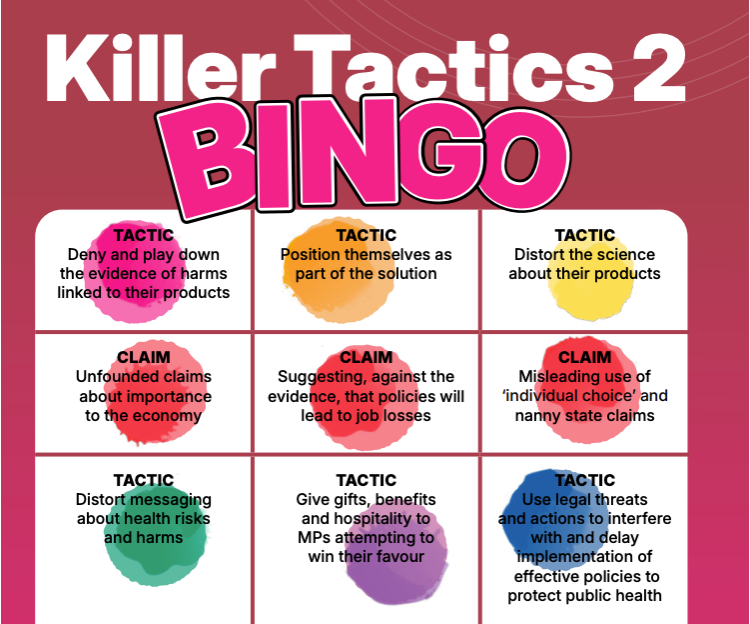
It’s a game that keeps public health professionals on their toes – and most of the public in the dark.
The consequences are serious: policy manipulation undermines evidence-based decision-making, protects commercial interests over lives, and worsens health inequalities. Vulnerable communities bear the brunt, suffering disproportionate harm from alcohol, tobacco, and unhealthy foods.
The report is also a clear call to action: the new government must enforce transparency, resist commercial pressures, and put public health first.
Catch up on the launch webinar here.
Tens of thousands of essential frontline workers could be funded by alcohol duty
The Alcohol Health Alliance has launched an online calculator that shows how many nurses, police officers, teachers, or firefighters could be funded if the government introduces an alcohol duty escalator.
The escalator would increase duty rates by a set percentage above inflation, with a 2% escalator estimated to raise an additional £3.4 billion over five years. This could fund and sustain the salaries of over 37,000 NHS nurses, 37,000 police officers, 35,000 teachers, or 30,000 firefighters.
When a duty escalator was in place under the previous Labour Government, it was the only time in recent history that the alcohol death rate consistently fell.
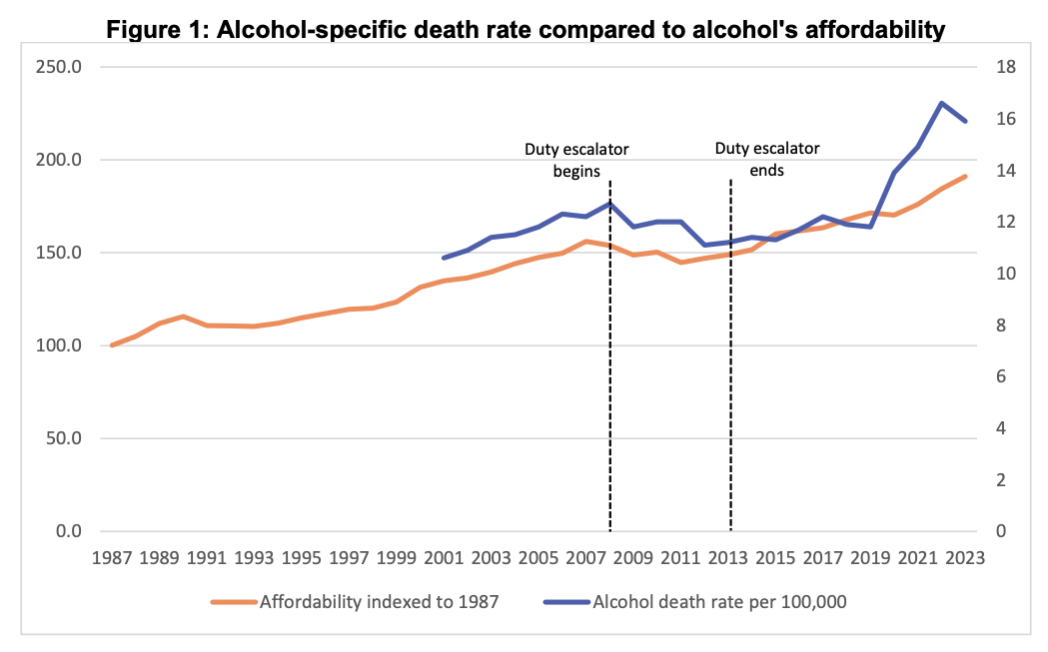
The AHA wrote to Exchequer Secretary Dan Tomlinson to highlight the importance of raising duty rates for both public health and Treasury revenue.
Professor Sir Ian Gilmore, chair of the Alliance, said:
“Alcohol duty is one of the most effective tools the government has to protect public health and support economic growth. It can encourage people back to pubs, where the social and economic benefits are felt across communities, while raising the vital funds for public sector services that this country is crying out for. We urge the Treasury to act decisively in this Autumn Budget — to save lives and support essential services.”
Alcohol industry ramps up pressure on government for tax cuts despite near record sales
As the Autumn Budget approaches, alcohol industry lobbyists are stepping up their campaign for duty cuts – warning of job losses, falling revenues, and even rising inflation if the Chancellor fails to act.
Trade groups from the Scotch Whisky Association (SWA) to the Wine and Spirit Trade Association (WSTA) have issued numerous pleas for cuts to alcohol duty, backed by major producers and industry-linked MPs. The All-Party Parliamentary Beer Group has called for a 5% beer duty cut, while the UK Spirits Alliance insists that only a “complete freeze on excise duty” can save Britain’s distillers.
Big business leaders have joined the chorus. Greene King’s CEO Nick Mackenzie urged immediate tax relief for pubs, claiming the sector faces a £300 million surge in costs. The Scottish Chambers of Commerce called a freeze “an investment in British business”, echoing the SWA’s demand to hold duty until 2029. Even trade unions such as GMB Scotland have aligned with industry on this issue, arguing it will “safeguard jobs”.
But behind the rhetoric of hardship lies a different reality. According to industry coverage of the latest ONS data, Britons spent a staggering £27.4 billion on off-trade alcohol last year – nearly matching record pandemic levels. Spirits alone accounted for £7.8 billion in off-trade sales, only marginally down from 2023’s record year. Despite claiming to be crushed by tax, the sector remains hugely profitable, with companies continuing to expand exports and report strong returns.
Calls for duty cuts ring hollow when profits remain so high and alcohol harm continues to cost the NHS and wider economy billions each year.
Half of alcohol-free adverts break the rules

The UK Advertising Standards Authority (ASA) has found that 48% of adverts for alcohol-free products could be non-compliant with advertising rules.
The main issues were adverts that either didn’t include the drink’s strength by ABV, or it was unclear. The UK’s self- and co-regulated advertising codes require alcohol alternatives to have a “prominent statement” on ABV levels.
The ASA stated that a “noticeable proportion [of issues were] from smaller or newer advertisers”, and that it plans to publish advice for the sector.
Across the water in Ireland, an Amendment to their Public Health (Alcohol) Bill has been introduced, which closes the loophole on zero alcohol advertising.
It will stop alcohol companies from using the same branding, logos, and imagery on their ‘zero-alcohol’ products as their regular alcoholic drinks.
Alcohol Action Ireland (AAI), which has been campaigning for these changes, welcomed the move as long overdue. CEO Dr Sheila Gilheany argued that zero-alcohol branding is essentially alcohol marketing disguised with a small “0.0” label, undermining the intent of the Act to limit children’s exposure to alcohol marketing.
“It’s naïve to think that ‘0% alcohol’ is anything other than a smoke screen – it’s 100 per cent alcohol marketing.”
“Can we really trust what our children are being taught?”
Earlier this month, ADPH President Greg Fell raised serious concerns about the influence of commercial interests in UK schools. In his new blog, he highlights how alcohol, gambling, and junk food industries fund ‘educational’ programmes that misrepresent risks, normalise harmful behaviours, and shift responsibility onto children rather than the companies selling these products.
Fell warns that while teachers are not to blame, children are being exposed to industry influence hidden behind glossy materials and charities – echoing tactics used by tobacco and fossil fuel companies in the past. As Chris van Tulleken has noted on the topic:
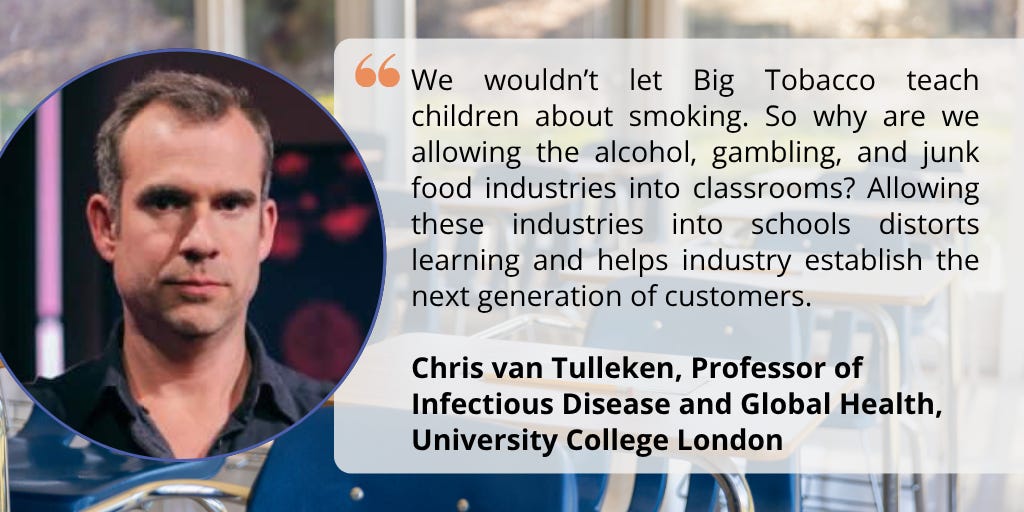
Earlier this year, 58 organisations wrote to the Education Secretary, urging action to remove misleading industry-funded materials from schools. IAS will soon publish a report on this issue and will continue to push the government to stipulate that schools should only use independently produced resources.
MSPs vote against legal right to addiction treatment
Scottish Parliament has voted 63 votes to 52 to reject the Right to Addiction Recovery (Scotland) Bill.
The legislation would have given anyone diagnosed as having a drug or alcohol addiction the right to treatment within three weeks of their diagnosis, including residential rehabilitation, community-based treatment, detoxification, substitute prescriptions or any other treatment recommended by a health professional. It also would have allowed a person who had been diagnosed with a drug or alcohol addiction to participate in decisions about their treatment.
Holyrood’s health committee did not recommend the parliament support the Bill, concluding it was not the “correct vehicle” to help those with addictions. Convener Clare Haughey said the Bill would require significant amendments to be workable, and that by only applying to those with a formal diagnosis, could exacerbate stigma, create barriers to recovery, and risk legal challenges over the right to treatment.
Drug and alcohol policy minister Maree Todd said while ministers supported the Bill’s “ambition,” they could not support it considering the “profound legal, practical, and resource concerns that risk undermining service delivery rather than enhancing it”.
Former Scottish Conservative leader Douglas Ross, who tabled the Bill, had urged those with reservations to allow the bill to pass at stage one, arguing that concerns could be addressed at a later stage of the legislative process: “Surely the fundamental thing is to save lives, and we have that opportunity to do that today.”
Scottish Health Action on Alcohol Problems (SHAAP) has previously expressed concern that the Bill, as drafted, could be ineffective or even counterproductive, warning:
“Introducing a right to treatment without carrying out the steps above first [on resourcing and standards of care], risks putting in place a right to treatment that is not properly resourced nor of sufficient quality, and as a result is not effective and lets down the very people the Bill wishes to better support.”
WHO Western Pacific countries adopt landmark alcohol policy plan
Countries across the WHO Western Pacific Region have adopted a comprehensive new regional plan to accelerate implementation of the WHO Global Alcohol Action Plan 2022–2030.

The resolution, endorsed by 17 Member States and supported by civil society organisations including Movendi International and Vital Strategies, recognises alcohol as a leading cause of death and disability in the region, responsible for over 485,000 deaths annually, disproportionately affecting young people, women, Indigenous communities, and disadvantaged populations.
The plan promotes evidence-based SAFER interventions, including raising alcohol taxes, limiting availability, restricting marketing, strengthening alcohol-impaired driving measures, expanding treatment access, and increasing public awareness. It also explicitly addresses alcohol industry interference and commits to safeguarding public health policy-making.
To support implementation, WHO Western Pacific has launched the #AlcoholLeavesAMark campaign, aimed at engaging policymakers, mobilising advocates, and highlighting the societal and health harms of alcohol. Experts hope the plan will transform regional action, protect communities, and save lives.
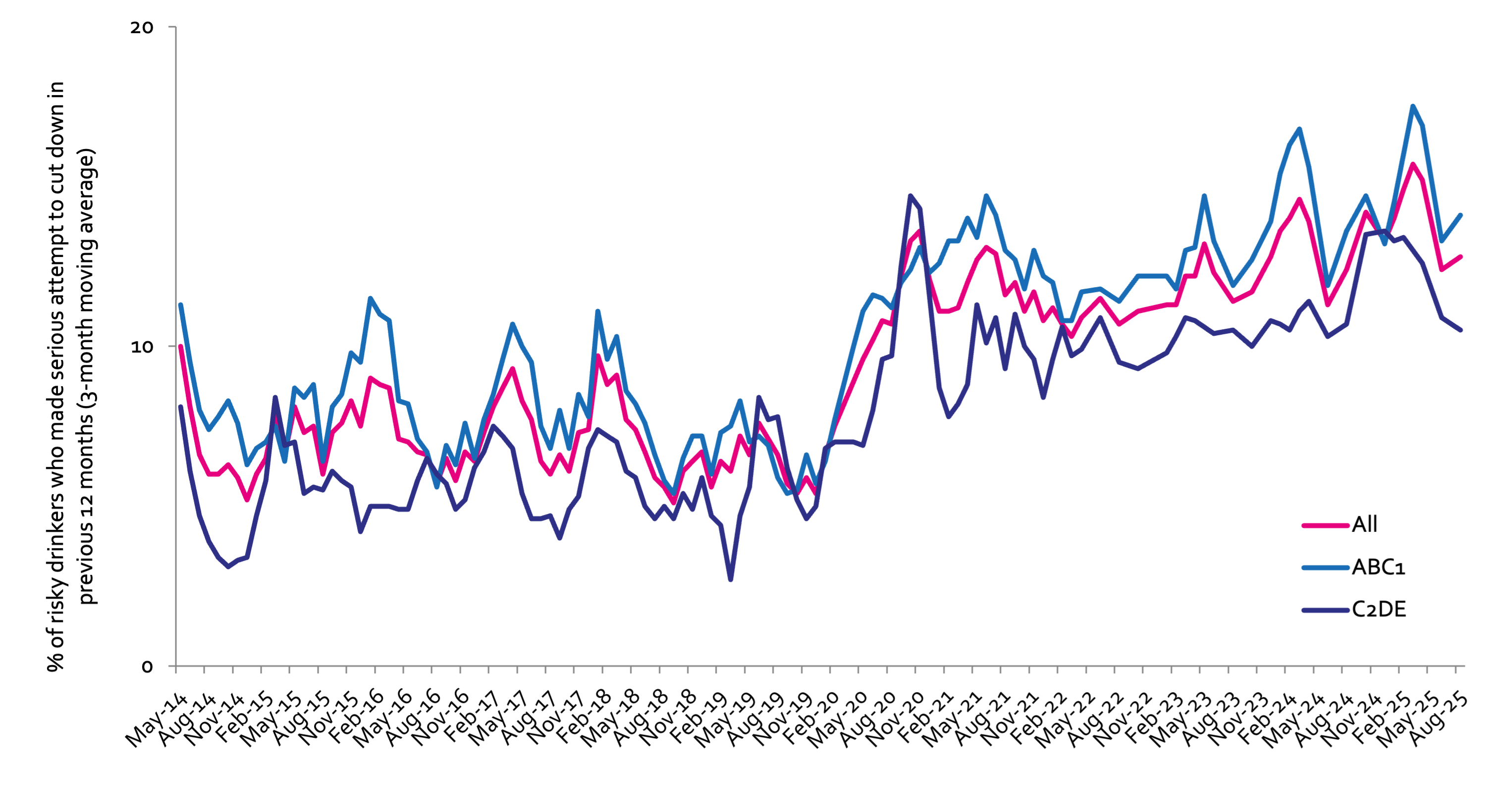
Alcohol Toolkit Study: update
The monthly data collected is from English households and began in March 2014. Each month involves a new representative sample of approximately 1,700 adults aged 16 and over.
See more data on the project website here.
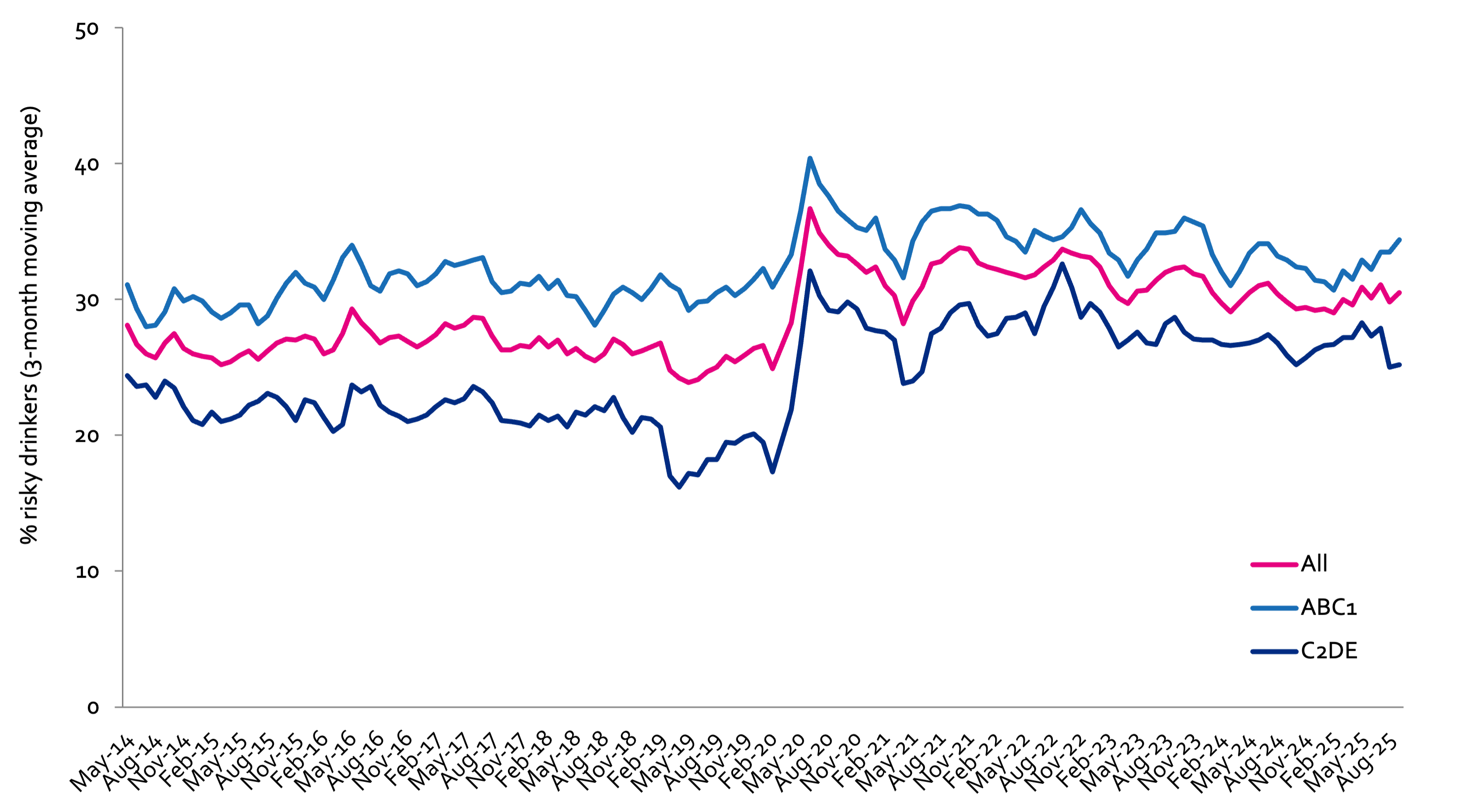
Prevalence of increasing and higher risk drinking (AUDIT-C)
Increasing and higher risk drinking defined as those scoring >4 AUDIT-C. A-C1: Professional to clerical occupation C2-E: Manual occupation
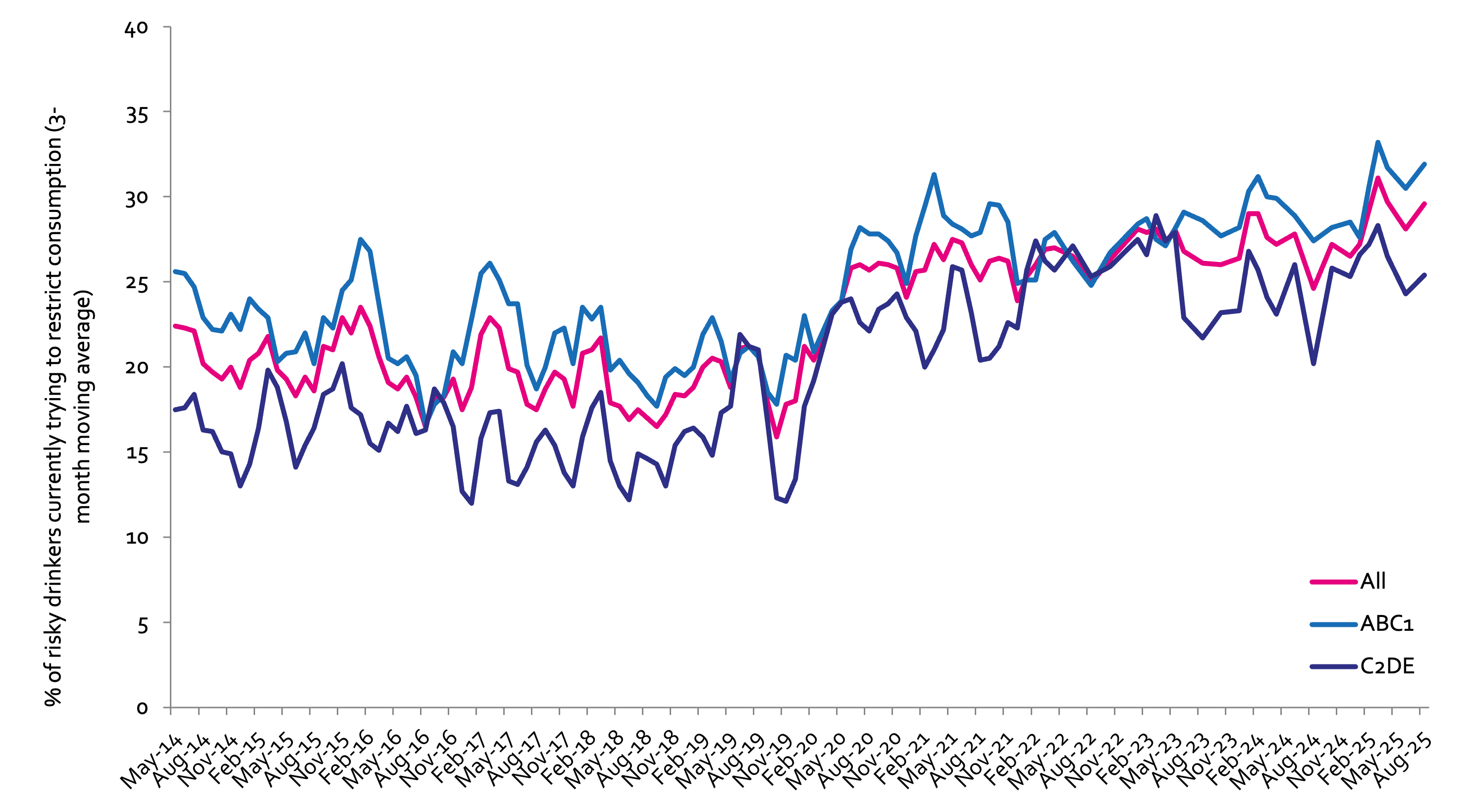
Currently trying to restrict consumption
A-C1: Professional to clerical occupation C2-E: Manual occupation; Question: Are you currently trying to restrict your alcohol consumption e.g. by drinking less, choosing lower strength alcohol or using smaller glasses? Are you currently trying to restrict your alcohol consumption e.g. by drinking less, choosing lower strength alcohol or using smaller glasses?
Serious past-year attempts to cut down or stop
Question 1: How many attempts to restrict your alcohol consumption have you made in the last 12 months (e.g. by drinking less, choosing lower strength alcohol or using smaller glasses)? Please include all attempts you have made in the last 12 months, whether or not they were successful, AND any attempt that you are currently making. Q2: During your most recent attempt to restrict your alcohol consumption, was it a serious attempt to cut down on your drinking permanently? A-C1: Professional to clerical occupation C2-E: Manual occupation
The UK Alcohol Alert (incorporating Alliance News) is designed and produced by The Institute of Alcohol Studies. Please click the image below to visit our website and find out more about us and what we do, or the ‘Contact us’ button. Thank you.
